
Stock Returns & The Next President
- Oct 12, 2016
- 3 min read
After both the Dow and the S&P 500 got off to the worst start in history, stocks have bounced back and trended to new all time highs.
Dec 31, 2015 - Oct 11, 2016
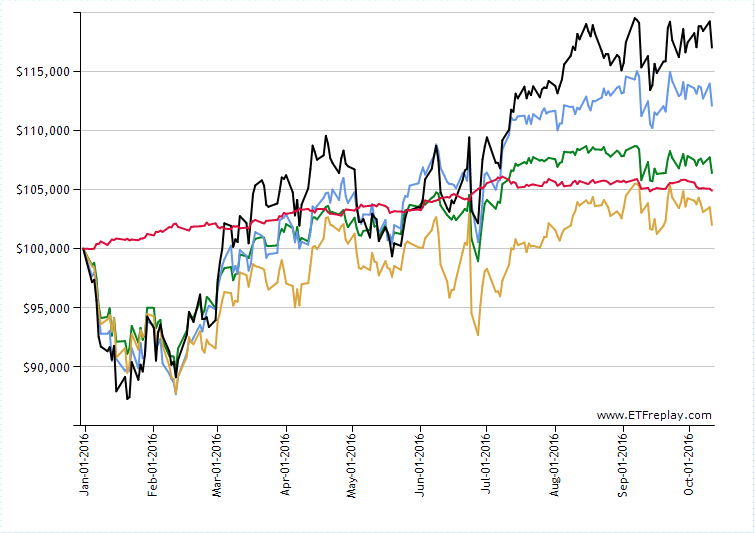
US Large Caps (6.4%), US Small Caps (12.1%), International Stocks (2.0%), Emerging Market Stocks (17.0%), Bonds (4.9%)
Ticker Symbols Used In Chart (in order): IVV, IJR, VEA, VWO, AGG
Despite a nice little mini run in the markets, many of the self professed "experts" are predicting increased volatility fueled by the upcoming election. While this election feels exceptionally polarizing (don't they all?), there is no valid reason to think investors can profit from preemptive market moves. The reality is that stock prices generally reflect all known information, and millions of other investors have already beat you to the best performing sector of the first quarter of 2017.
To back up my position, allow me to share the most sensible commentary I've come across regarding the election as it relates to stocks. It's based on real data, not just speculation and hype.
The following is adapted from Dimensional Fund Advisors October piece Presidential Elections And The Stock Market...
NEXT MONTH, AMERICANS WILL HEAD TO THE POLLS TO ELECT THE NEXT PRESIDENT OF THE UNITED STATES
While the outcome is unknown, one thing is for certain: There will be a steady stream of opinions from pundits and prognosticators about how the election will impact the stock market. As we explain below, investors would be well‑served to avoid the temptation to make significant changes to a long‑term investment plan based upon these sorts of predictions.
SHORT-TERM TRADING AND PRESIDENTIAL ELECTION RESULTS
Trying to outguess the market is often a losing game. Current market prices offer an up-to-the-minute snapshot of the aggregate expectations of market participants. This includes expectations about the outcome and impact of elections. While unanticipated future events—surprises relative to those expectations—may trigger price changes in the future, the nature of these surprises cannot be known by investors today. As a result, it is difficult, if not impossible, to systematically benefit from trying to identify mispriced securities. This suggests it is unlikely that investors can gain an edge by attempting to predict what will happen to the stock market after a presidential election.
LONG-TERM INVESTING: BULLS & BEARS ≠ DONKEYS & ELEPHANTS
Predictions about presidential elections and the stock market often focus on which party or candidate will be “better for the market” over the long run. The chart below shows the growth of one dollar invested in the S&P 500 Index over nine decades and 15 presidencies (from Coolidge to Obama). This data does not suggest an obvious pattern of long-term stock market performance based upon which party holds the Oval Office. The key takeaway here is that over the long run, the market has provided substantial returns regardless of who controlled the executive branch.
GROWTH OF A DOLLAR INVESTED IN THE S&P 500 (JAN '26 - JUN '16)

Disclaimer: Past performance is not a guarantee of future results. Indices are not available for direct investment; therefore, their performance does not reflect the expenses associated with the management of an actual portfolio. The S&P data is provided by Standard & Poor’s Index Services Group.
CONCLUSION
Equity markets can help investors grow their assets, but investing is a long-term endeavor. Trying to make investment decisions based upon the outcome of presidential elections is unlikely to result in reliable excess returns for investors. At best, any positive outcome based on such a strategy will likely be the result of random luck. At worst, it can lead to costly mistakes. Accordingly, there is a strong case for investors to rely on patience and portfolio structure, rather than trying to outguess the market, in order to pursue investment returns.


Comments