
Put Your Money Where Your Heart Is
- Dec 11, 2015
- 6 min read

You're supposed to have a diversified portfolio. What happens when you look under the hood and find your funds contain stocks you don't agree with?
Perhaps your values predispose you to investing in companies deriving revenue from objectionable sources such as gambling, pornography, or alcohol. Maybe you're a deep green environmentalist and you don't want to invest in fossil fuel related stocks.
Whatever you believe in (or don't believe in) is a product of many biases; your parents, the media, the industry you work in, or your spouse. For many people, their biases create especially strong values. If you strive to live your life according to those values, why should you stop at your investment portfolio?
When you choose to structure your investments around environmental or social values, you are what's referred to as a socially responsible investor. Last week I wrote about how to Tilt Your Portfolio Towards Certain Types of Stocks. In many respects, Socially Responsible Investing (SRI) can be thought of as an extension of that tilting.
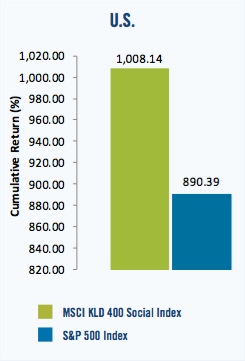
Historically, SRI has taken an exclusionary approach to stocks. Don't want Wal-Mart, Monsanto, or Exxon in your portfolio? No problem. Let's blow 'em out of there. Some people in the industry maintain this rigidity reduces diversification. They are absolutely correct. However, a little bit of rigidity may benefit investors, as referenced in my post regarding Volkswagen's Recent Emissions Scandal. However, the real question is does excluding companies (or industries) increase or decrease historical returns?
The KLD 400 Social 400 index has been tracking U.S. large companies with strong SRI track records for 25 years. The chart on the right is how it has performed compared to its conventional large cap benchmark, the S&P 500*.
According to index designer MSCI Inc, the index "provides exposure to companies with outstanding Environmental, Social and Governance (ESG) ratings and excludes companies whose products have negative social or environmental impacts". More specifically, the index excludes companies involved in Nuclear Power, Tobacco, Alcohol, Gambling, Military Weapons, Civilian Firearms, GMOs and Adult Entertainment. Companies with strong Environmental, Social, and Governance track records are overweighted.
Cumulatively, the KLD 400 index has outperformed the S&P 500 by 117.75% since the social index's inception in 1990. To put this into perspective, a $100,000 investment in the social index would've grown to $1,221,185 today. The same initial investment in the S&P 500 would've grown to $1,079,715**.
Another way to approach SRI is to focus exclusively on ESG factors. This strategy overweights "good" companies and underweights (sometimes significantly) "bad" companies. ESG analysis consists of a scoring system; the better a company manages for ESG sustainability, the higher the score. It is very much a tilting approach. Here's a broader view of criteria used in ESG analysis.
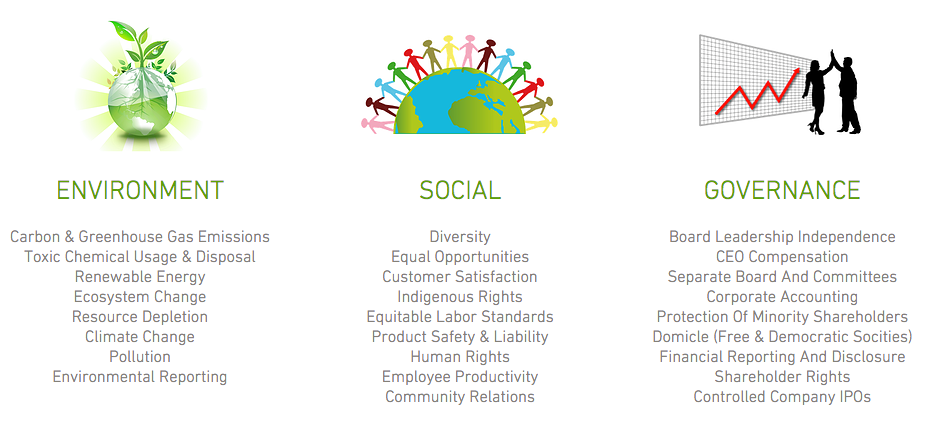
The ESG portfolio philosophy is the most popular SRI strategy in terms of dollars, with $6.57 trillion in U.S. invested assets***. Most of these dollars come from institutional investors- pensions, endowments, & universities. The rest of us seem interested too. When asked, 71% of investors are interested in sustainable investing****.
Last month I attended a multi day SRI conference and had the opportunity to chat with many SRI minded asset managers. One of them was Chris McKnett, head of ESG investing at State Street Global Advisors. We chatted about how both large investors (the ones Chris works with) and smaller retail investors (the ones I work with) are moving from conventional portfolio management to an investment design reflecting investor values. Here he is speaking about ESG concepts at a TED conference in November, 2013. This short video is the best ESG summary I've seen.
SRI isn't just a U.S. phenomenon. We've seen similar results internationally as evidenced by the MSCI EAFE ESG Index. Not only has this index outperformed its conventional benchmark, it's done with so less risk since it's inception in November, 2007*****.

For more evidence on historical SRI & ESG performance, here is some additional research.
At this point you have clear evidence you can align your environmental & social values with your portfolio, and at the same time earn a competitive, if not outperforming return. The question now is will you acknowledge your current portfolio contains stocks with less than stellar track environmental or social track records? To help you decide, try any of these free online tools to help understand what's really in your portfolio.
Decarbonizer - nice output measuring carbon intensity of major market indices, your portfolio, or even institutional endowments & pensions. The tool generates specific recommendations regarding which stocks should be removed and which stocks could be added.
Fossil Free Funds - another tool to flag specific companies within a specific fund or portfolio. This tool also provides a list of funds filtered by how diversified they are, clean funds only, and / or socially responsible funds.
In partnership with the ESG scoring company Sustainalytics, Morningstar plans to unleash their own ESG tool sometime soon, but I haven't seen it in either Morningstar's free or paid subscriptions yet. Hopefully it will pop up soon.
If you're ready to restructure your portfolio, investors can use the free mutual fund finder tool at Socialfunds. The challenge with this site is piecemealing funds together to create a globally diversified portfolio. The other big challenge is the majority of the funds listed are expensive, actively managed options. I've contacted Socialfunds a few times with encouragement to update their fund list, but 1. haven't heard back, and 2. haven't seen any change. Presenting all the options is absolutely critical because so much research favors return returns from passive strategies. S&P Dow Jones Indices provides evidence that SRI Indices Outperform and Cost Less Than Actively Managed Strategies.
Investors wishing to use 100% low cost, tax efficient investments (a passive strategy) combined with SRI values currently have only one place in the United States to go- my company******. Someone recently told me I'm ahead of my time. I disagree. Thie industry is already buzzing with SRI & indexing strategies. Here are three articles I've had published on this topic.
Values matter. So does portfolio value. The financial industry has finally started to bring low cost, tax efficient index strategies to market. By summer 2016, I expect the amount of passively managed SRI & ESG strategies to double.
Investing according to your values isn't just for righteous tree huggers. In fact, you don't even have to believe in climate change. There is zero rationale to allow your bias to override the evidence that paying attention to sustainable companies has historically rewarded investors. You want the best return for the lowest expected risk (said every investor I've ever chat with), right ? Don't ignore environmental & social considerations in your portfolio.
To learn about how I combine a sensible, low cost strategies with values, please visit our Portfolio Page and Investment Philosophy. Use the Shoot Us An Email form in the site footer to ask questions about an ESG or customized SRI portfolio.
* The MSCI KLD 400 Social Index has outperformed the S&P 500 by 117.75% cumulative from 05/01/90 to 09/30/15. Returns since index inception are shown gross which includes dividend reinvestment without a reduction from tax. Past performance is no guarantee of future results. Investors cannot buy an index directly.
** Calculations using SEC compound interest calculation available at Investor.gov, $100,000 starting balance, 25.3 years to grow, 9.92% annualized interest rate (social index), 9.43% annualized interest rate (S&P 500), 12 compounding periods per year.
*** Report on US Sustainable, Responsible, and Impact Investing Trends, USSIF Foundation, 2014.
**** Sustainable Signals: The Individual Investor Perspective. Morgan Stanley Institute for Sustainable Investing. Feb. 2015.
***** The MSCI EAFE ESG Index has outperformed the MSCI EAFE Index by 5.38% cumulative from 10/01/07 to 09/30/15 Past performance is no guarantee of future results. Investors cannot buy an index directly.
****** I pioneered this concept in late 2014 within Aspen Leaf Partners Green Return portfolio models. As of May, 2015 I haven't been able to identify another asset management firm promoting a complete portfolio of passively managed SRI funds.


Comments